
home elevation
may 6-16, 2026
Opening reception | May 6, 2026 - 5:00-7:00 pm
To raise a house, it must first be uprooted from the underground networks of utilities¾water, sewer, gas, electricity, internet, and telephone service. Steel beams, hydraulic jacks, and stacked 6x6 timbers are then placed in layers under the floor joists to elevate the structure. A great part of the work is remedying defects, such as misaligned walls, underpinning foundations, and irregular settle.
House lifting is both a technical process and a cultural practice done in anticipation of rising water. As a building method, it responds to unpredictable climate, saturated soil, and changing water courses. Built on swampland, the southern coast of Louisiana saw major shifts over the past three hundred years. Today, heavy rainstorms, hurricanes, and floods continue to haunt houses built on the lowlands, leaving those living in the lower portion of the city extremely vulnerable.
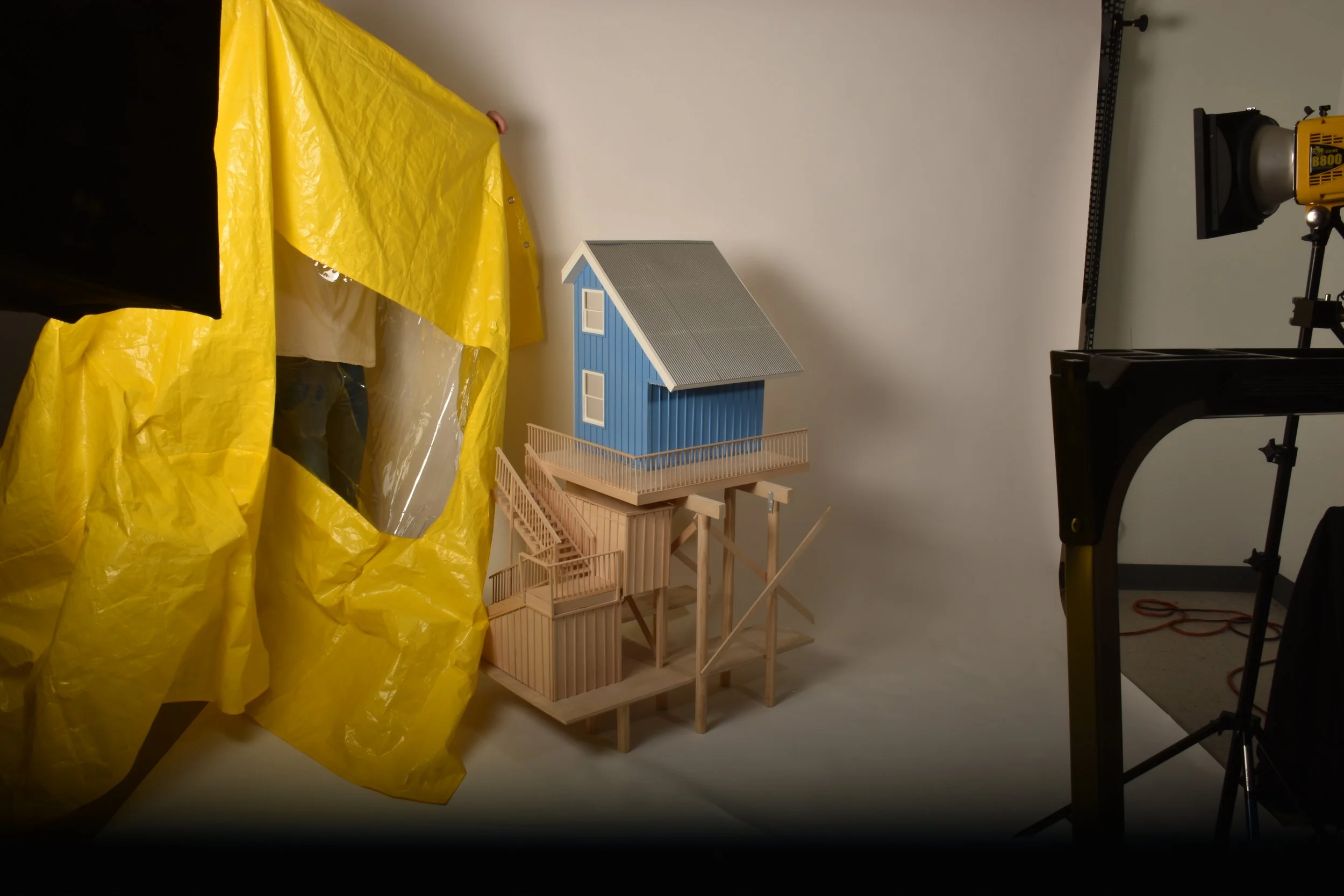
The raised homes are moving figures between bodies of water and land: a pre-manufactured home supported by wooden piles 20 feet in the air; an A-Frame sitting on a field of concrete columns; a historic 19th century Central Hall cottage resting on orthogonal cribbing; a Quonset hut lifted by two shipping containers doubling as a shrimp processing station. These architectural anomalies are not by accident. FEMA Base Flood Elevation mandates minimum ground floor heights, local building codes reinforce compliance, and flood insurance premiums encourage continuous lifting.
Home Elevation builds upon previous design research projects by DoZa (Shirley Dongwei Chen and Maria Espinoza) focused on building practices that emerge from necessity¾responding to climate, material, and infrastructure instability. Rather than seeing house raising as a neutral engineering solution, the exhibitioninvites us to consider what kinds of spatial, ecological, and sociotechnical transformations are enacted in the building practice of house lifting, and who is afforded the ability to rise above the floodplain.
DoZa is a New Orleans and Denver based design research practice founded by Maria Espinoza and Shirley Dongwei Chen. DoZa has exhibited internationally at Biennale d’Architecture et de paysage d’Île de France (BAP! 2025) and the Tbilisi Architecture Biennale (2022). Their writings have appeared in Log, The Avery Review, Rumor, Room One Thousand, POOL, Paprika!, Lunch Journal, among others. @doza.obj (instagram)
Fabric Design and Installation: Max Bravo (Studio Everyone)
Student Research and Fabrication Assistants: Clayton Matthews, Catherine Nguyen, Em Booth
Home Elevation is supported by CU Denver College of Architecture and Planning (CAP), CU Denver Experience Gallery, and CAP Fall 2025-Spring 2026 Lecture and Exhibition Series. It is sponsored by CU Denver RDO Arts and Humanities Seed Grant and CAP Department of Architecture Faculty Award.